
Introduction to Diffusion of Innovation
 Bronislav Klučka, Apr 05, 2026, 10:20 AM
How do new ideas spread? How do you bring a new product to market? Can your product target an entire market segment?
In 1962, E. M. Rogers proposed a theory on the diffusion of new ideas and its application across cultures. This theory became the foundation of modern marketing and new product launches.
If you understand which groups are available to you and how you can reach them, you can target the market in a way that enables natural growth.
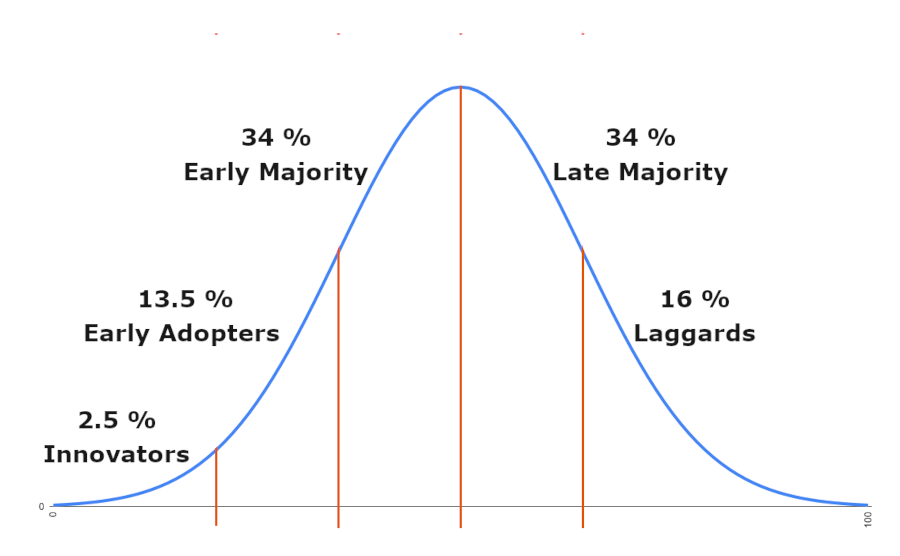
The Adopter Categories
Innovators - 2,5 %
The first group consists of innovators. Innovators are people who aren’t afraid to take risks. The main value a product holds for them is its novelty; the value of the product itself isn’t as important. They want to try it out. They often view their actions as a test; they don’t necessarily want to use the product, they want to play with it: “What can it do?”
Winning over this group isn’t difficult; the problem lies in their fickleness: they’ll stick around until something new comes along.
Early Adopters - 13,5 %
The second group consists of early adopters. This group often includes influential people and opinion leaders. The main value the product holds for them is its benefits. They aren’t afraid to discard the old if the new product is better.
Winning over this group is more difficult. Your product must have a clearly defined advantage over the established dominant product (or products).
This group then gives it a “stamp of approval” and says, “This product is worth it.”
Early Majority - 34 %
The third group is the early majority. This group consists of pragmatic people who need to know that a product works. In this case, the main value is proven reliability.
The Chasm
This group is the hardest to win over. The early majority will evaluate whether it’s worth abandoning old ways and switching to new ones. They will assess the costs of phasing out the old product and transitioning to the new one. This is often the biggest challenge: it’s not just about adopting the new product, but about transitioning from the old one.
If they replace the old machine model with a new one, how much will installation cost? How much will it cost to train employees on the new machine? How many defective products will be produced before they reach the previous quality level? How long will it take before they reach the previous level of efficiency?
If you replace the old software with new software, how much will it cost to transfer all data from the old system to the new one? How much will training cost? How long will it take for employees to get used to the new interface?
In this case, it’s not just about the value of the new product, but also the costs of the transition.
And that’s why this group is the hardest to win over.
However, if you make it into this group, then you’ve won: your product has gained “social status”—it’s normal to use it.
Late Majority - 34 %
The fourth group is the late majority. This group consists of skeptics who believe in the old ways, and their primary value is security.
This group adopts new products only after the majority of the population has done so, primarily for economic reasons (a desire not to fall behind) – “everyone else is doing it, so we have to as well.”
Laggards - 16 %
The last group consists of the laggards. This group represents traditionalists who stick to the old ways as long as they exist. They value their own way of doing things and will only change it if the product in question simply ceases to exist.
Communication - Marketing
Each of these groups requires its own communication approach and marketing strategy. However, I would argue that it’s not worth targeting the late majority and laggards:
The late majority will come on board only when they need it themselves. You just have to be ready for that; you have to be the “default choice.” Nevertheless, the late majority represents a significant revenue driver.
Laggards will only join in after de facto standardization or necessity. You have to wait for external factors. Here, you need to consider whether this is a regulated segment that could ultimately represent a large market.
So how should you communicate a new product to others? The most common mistake is to target the majority right away. Given what I described above (the gap), they won’t even consider you. You’re too new, untested; they don’t know if your product is worth it, if it’s stable enough, or if your company is stable enough…
Start small.
Innovators
This is where you need to start.
There are two types of innovators. The first type wants to gain an advantage, wants to be first, and enjoys technology. Your marketing must focus on what’s new—what your product can do that established products cannot.
The second type sets itself apart from what came before. Your marketing must focus on rejecting what already exists—it’s “outdated” or even “bad.” Don’t be afraid to directly mention that you don’t do things the same way as the big players; on the contrary, that’s your advantage.
How are you different from those who came before you?
You represent a new perspective, a rejection of big corporations, a rejection of the old order. You represent freedom of choice.
Innovators are a great source of feedback and testing. They’ll cut you a lot of slack, and thanks to them, you can fine-tune your product.
Early Adopters
You’ll likely find early adopters where your competitors haven’t yet established a presence and where the company is young and hasn’t fallen into a rut. Startups and similar companies are a great target for you.
Innovators have tested your product, and you can focus on promoting its benefits.
How are you better than those who came before you?
Your marketing should include measurable data on the benefits of your product, which you’ll obtain thanks to the innovators.
Early Majority
When communicating with this group, you need to adjust your tone. While in previous cases you could be more assertive and set yourself apart from others, this approach won’t work with the early majority. The early majority wants stability. These customers are interested in how long you’ve been in the market, how many customers you have, what kind of customers they are, and how well you’re doing. Testimonials from companies similar to theirs are key for them.
In what ways are you just as stable as others?
If this group is looking for a replacement for their current product or considering a new one, they look around to see what others are doing.
The aim of this article was to highlight the fact that you can’t bring a new product straight into the mainstream (unless it’s a complete revolution—even the iPhone took two years to become a mainstream product). You need to gradually build a user base and understand who to communicate with and how.